Interdependency Maps
Purpose
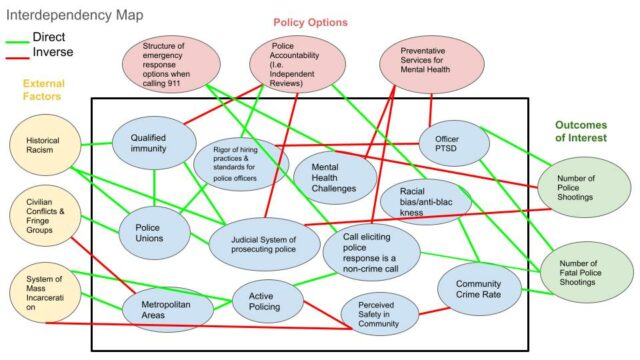
Interdependency maps are used to visually represent the complex web of relationships and dependencies among various factors and issues within a problem situation. These maps help to clarify the interconnectedness of elements contributing to a problem, highlighting how changes in one area can cascade and impact others. Visualizations of this sort facilitate a shared understanding of a problem’s systemic nature, allowing researchers or policy analysts to identify key leverage points, potential unintended consequences, and the need for coordinated interventions. These maps help to move beyond assumptions of cause and effect and foster a holistic view essential for effective intervention and implementation.
| Uses | Limitations |
|---|---|
|
|
When to Utilize
Interdependency maps are used when tackling complex, interconnected issues where understanding the relationships between factors and potential interventions is crucial. They are particularly valuable during the initial stages of inquiry to visualize the system’s dynamics, identify key stakeholders, and understand how different elements influence each other. When facing problems with multiple contributing factors and potential unintended consequences, these maps help to develop a holistic view, enabling them to design more effective and coordinated interventions. They are important when a systemic understanding is needed to navigate and address complex policy challenges.
Resources
Frantzeskaki & Walker, Concepts and Methods for Policy Analysis, 2013
Thissen & Walker, Public Policy Analysis: New Developments, 2013
Return to methods Previous Post
 Next Post
